
Default
What’s the Difference Between a Laboratory Wall Bench and a Lab Island Bench?
In terms of the core parameter of space utilization rate, laboratory wall bench shows significant differences from island workbench. Wall-mounted workbenches are usually installed along the wall, with a depth range of 600 to 800 millimeters. They can fully release the central area, increasing personnel flow efficiency by up to 30%. On the contrary, as an independent unit, the standard size of the island workbench is usually 1500mm × 750mm. Although it provides four-sided operation channels, it occupies approximately 2.25 square meters of precious floor area. For instance, in the design of a cell culture laboratory in 2023, Novartis successfully deployed 12 workstations within a 60-square-meter space by adopting a wall-mounted solution, while the island design could only accommodate 8, increasing the space density by 50%.
From the analysis of initial investment and life cycle cost, the differences are equally obvious. The purchase cost of a standard configuration laboratory wall-mounted workbench is approximately 5,000 yuan per linear meter, with installation costs as low as 10% of the total price. Moreover, due to its simple structure, the maintenance cycle can be extended to 24 months, reducing the average annual maintenance cost by about 15%. Due to the need for an independent support structure and more complex pipeline connection, the initial cost of the island workbench is about 40% higher. Moreover, it is difficult to move and modify, and the reorganization cost may account for 25% of the original value of the equipment. According to the 2024 laboratory furniture market analysis, over 60% of small and medium-sized laboratory projects with a budget of less than 1 million yuan tend to choose wall-mounted solutions to achieve cost controllability.
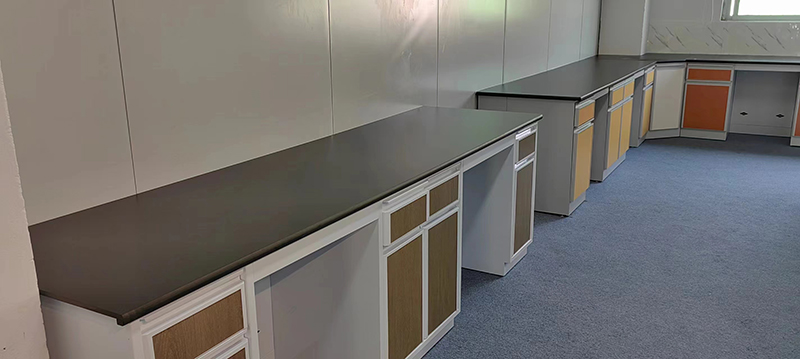 The workflow and collaboration mode are also deeply influenced by choices. The island workbench supports 360-degree access and is suitable for complex experiments that require the collaborative operation of multiple researchers. It can increase team communication efficiency by approximately 20%, but it may increase the risk of cross-contamination by 50%. laboratory wall bench creates a linear workflow, which is particularly suitable for serialized operations that require high concentration, such as standard sample processing. It can reduce the unnecessary movement distance of the operator by 60% and the error rate by 5%. As Merck Group pointed out in an internal assessment report in 2022, after they changed the high-throughput screening area from an island layout to a wall-mounted layout, the sample testing throughput increased from 1,000 per day to 1,400, with a growth rate of 40%.
In terms of adaptability and technological integration, the two are taking different paths. Modern island workbenches can support large equipment weighing over 500 kilograms and are easy to integrate central gas valves and power modules, with a power support of up to 10 kilowatts. The wall-mounted design demonstrates unique flexibility in responding to the trend of laboratory intelligence. For instance, it integrates sensors to monitor temperature and humidity, with an adjustable installation height range of 750 to 950 millimeters and an accuracy error of less than 1 millimeter. A survey on biosafety laboratories shows that in environments above P2 level, choosing a wall-mounted layout can optimize air flow organization and increase air exchange efficiency by 15%, which is crucial for risk control. The ultimate choice is not a simple judgment of good or bad, but a strategic decision based on spatial parameters, workload intensity, and the probability of future expansion.
The workflow and collaboration mode are also deeply influenced by choices. The island workbench supports 360-degree access and is suitable for complex experiments that require the collaborative operation of multiple researchers. It can increase team communication efficiency by approximately 20%, but it may increase the risk of cross-contamination by 50%. laboratory wall bench creates a linear workflow, which is particularly suitable for serialized operations that require high concentration, such as standard sample processing. It can reduce the unnecessary movement distance of the operator by 60% and the error rate by 5%. As Merck Group pointed out in an internal assessment report in 2022, after they changed the high-throughput screening area from an island layout to a wall-mounted layout, the sample testing throughput increased from 1,000 per day to 1,400, with a growth rate of 40%.
In terms of adaptability and technological integration, the two are taking different paths. Modern island workbenches can support large equipment weighing over 500 kilograms and are easy to integrate central gas valves and power modules, with a power support of up to 10 kilowatts. The wall-mounted design demonstrates unique flexibility in responding to the trend of laboratory intelligence. For instance, it integrates sensors to monitor temperature and humidity, with an adjustable installation height range of 750 to 950 millimeters and an accuracy error of less than 1 millimeter. A survey on biosafety laboratories shows that in environments above P2 level, choosing a wall-mounted layout can optimize air flow organization and increase air exchange efficiency by 15%, which is crucial for risk control. The ultimate choice is not a simple judgment of good or bad, but a strategic decision based on spatial parameters, workload intensity, and the probability of future expansion.
The workflow and collaboration mode are also deeply influenced by choices. The island workbench supports 360-degree access and is suitable for complex experiments that require the collaborative operation of multiple researchers. It can increase team communication efficiency by approximately 20%, but it may increase the risk of cross-contamination by 50%. laboratory wall bench creates a linear workflow, which is particularly suitable for serialized operations that require high concentration, such as standard sample processing. It can reduce the unnecessary movement distance of the operator by 60% and the error rate by 5%. As Merck Group pointed out in an internal assessment report in 2022, after they changed the high-throughput screening area from an island layout to a wall-mounted layout, the sample testing throughput increased from 1,000 per day to 1,400, with a growth rate of 40%.
In terms of adaptability and technological integration, the two are taking different paths. Modern island workbenches can support large equipment weighing over 500 kilograms and are easy to integrate central gas valves and power modules, with a power support of up to 10 kilowatts. The wall-mounted design demonstrates unique flexibility in responding to the trend of laboratory intelligence. For instance, it integrates sensors to monitor temperature and humidity, with an adjustable installation height range of 750 to 950 millimeters and an accuracy error of less than 1 millimeter. A survey on biosafety laboratories shows that in environments above P2 level, choosing a wall-mounted layout can optimize air flow organization and increase air exchange efficiency by 15%, which is crucial for risk control. The ultimate choice is not a simple judgment of good or bad, but a strategic decision based on spatial parameters, workload intensity, and the probability of future expansion.
Go from blank canvas to front door — fast.
Premium 12-color HD printing on archival satin paper. No sales calls, no minimums on most orders.