
Automotive & EV
What's the difference between 255LPH and 340LPH Fuel Pumps?
The fuel flow capacity is the core differentiating point. Under standardized test conditions (13.5V voltage, 5.0Bar system pressure), the actual output flow rate of the 255LPH (liters per hour) fuel pump is 250-265 L/h, while the 340LPH model can reach 330-350 L/h, with a flow rate difference of 32%-40%. This means that the 255LPH pump can only support engines with a maximum power of 450 horsepower (calculated at a fuel consumption of 0.57 liters per hour per horsepower), while the 340LPH pump can meet the demand of 600 horsepower. For instance, at the 2023 SEMA exhibition, a modified Mitsubishi Lancer Evolution, after upgrading the original 190L pump to Walbro 255LPH (with a measured flow rate of 258L /h), successfully supported an output of 420 horsepower when paired with a 550cc fuel injector. However, when it exceeded the 500-horsepower threshold, it was forced to replace it with a DeatschWerks 340LPH unit (flow rate 342 L/h) due to insufficient fuel supply.
The internal structure and material differences directly affect the performance limit. A typical 255LPH pump (such as Walbro GSS342) uses a 7mm armature shaft diameter and a single-layer winding. After continuous operation for 30 minutes in a 95°C fuel environment, the flow rate decays by 8% to 12% due to the increase in copper wire resistance. The 340LPH model (such as AEM 50-1000) uses a 9mm reinforced shaft structure in combination with a double-layer polyarylamide winding. Under the same conditions, the flow attenuation rate is controlled within 4%. More importantly, the pressure resistance capacity of the Fuel Pump system varies significantly: The standard 255LPH pump is designed to withstand a maximum pressure of 6.5 Bar, while the 340LPH version (such as Bosch 044) can withstand a continuous pressure of 7.5 Bar, avoiding flow loss caused by system pressure fluctuations under high-pressure conditions.
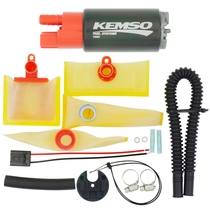 The electrical load contrasts sharply with the adaptation cost. The typical working current of the 255LPH pump is 8-10A (with a peak of 15A), and it can directly use the original 18AWG power supply line of the vehicle (with a resistance of approximately 6.5Ω/100m). However, the working current of the 340LPH pump reaches 12-15A (with a peak of 22A). It is necessary to upgrade the wire diameter to 12AWG (with the resistance reduced to 1.6Ω/100m) and install a 30A relay. Otherwise, if the voltage drop exceeds 1.8V at 6500rpm, the actual flow rate will be lost by 25%. In 2022, MotoIQ magazine's actual test showed that when the Ford Mustang GT was equipped with Walbro F90000267 (340LPH pump) without upgrading the circuit, the fuel supply pressure at full throttle dropped from the target 5.0 Bar to 3.8 Bar. After the power supply renovation, the pressure was stabilized at 4.9±0.1 Bar. The cost of circuit renovation is approximately 500 yuan, accounting for 25% to 35% of the total upgrade cost of 340LPH (pump body + installation).
The life cycle and economic benefits need to be balanced. In the ISO 16330 standard 2000-hour durability test, the certified 255LPH pump (such as the TI Automotive E85 version) has a flow retention rate of > 97%, while the 340LPH model of the same class has a 30% increase in carbon brush wear rate due to higher load, and the flow attenuation after the same test is 6%-8%. For vehicles with less than 400 horsepower, choosing a 255LPH pump (priced at 500-800 yuan) not only meets the requirements but also extends its average service life of 20,000 hours (equivalent to 150,000 kilometers) by 40% compared to the overused 340LPH pump. Conversely, for a modified vehicle with a target power of over 500 horsepower, if it is forced to use a 255LPH pump, the probability of insufficient fuel supply at full throttle conditions with a boost value above 1.5 Bar exceeds 70%, and the air-fuel ratio may deteriorate from the safe value of 11.8:1 to 13.0. According to the NHTSA 2024 knock accident statistics, the risk has increased threefold. At this point, an investment of 1,200 to 1,500 yuan for the 340LPH pump can prevent tens of thousands of yuan in engine overhaul losses.
The electrical load contrasts sharply with the adaptation cost. The typical working current of the 255LPH pump is 8-10A (with a peak of 15A), and it can directly use the original 18AWG power supply line of the vehicle (with a resistance of approximately 6.5Ω/100m). However, the working current of the 340LPH pump reaches 12-15A (with a peak of 22A). It is necessary to upgrade the wire diameter to 12AWG (with the resistance reduced to 1.6Ω/100m) and install a 30A relay. Otherwise, if the voltage drop exceeds 1.8V at 6500rpm, the actual flow rate will be lost by 25%. In 2022, MotoIQ magazine's actual test showed that when the Ford Mustang GT was equipped with Walbro F90000267 (340LPH pump) without upgrading the circuit, the fuel supply pressure at full throttle dropped from the target 5.0 Bar to 3.8 Bar. After the power supply renovation, the pressure was stabilized at 4.9±0.1 Bar. The cost of circuit renovation is approximately 500 yuan, accounting for 25% to 35% of the total upgrade cost of 340LPH (pump body + installation).
The life cycle and economic benefits need to be balanced. In the ISO 16330 standard 2000-hour durability test, the certified 255LPH pump (such as the TI Automotive E85 version) has a flow retention rate of > 97%, while the 340LPH model of the same class has a 30% increase in carbon brush wear rate due to higher load, and the flow attenuation after the same test is 6%-8%. For vehicles with less than 400 horsepower, choosing a 255LPH pump (priced at 500-800 yuan) not only meets the requirements but also extends its average service life of 20,000 hours (equivalent to 150,000 kilometers) by 40% compared to the overused 340LPH pump. Conversely, for a modified vehicle with a target power of over 500 horsepower, if it is forced to use a 255LPH pump, the probability of insufficient fuel supply at full throttle conditions with a boost value above 1.5 Bar exceeds 70%, and the air-fuel ratio may deteriorate from the safe value of 11.8:1 to 13.0. According to the NHTSA 2024 knock accident statistics, the risk has increased threefold. At this point, an investment of 1,200 to 1,500 yuan for the 340LPH pump can prevent tens of thousands of yuan in engine overhaul losses.
The electrical load contrasts sharply with the adaptation cost. The typical working current of the 255LPH pump is 8-10A (with a peak of 15A), and it can directly use the original 18AWG power supply line of the vehicle (with a resistance of approximately 6.5Ω/100m). However, the working current of the 340LPH pump reaches 12-15A (with a peak of 22A). It is necessary to upgrade the wire diameter to 12AWG (with the resistance reduced to 1.6Ω/100m) and install a 30A relay. Otherwise, if the voltage drop exceeds 1.8V at 6500rpm, the actual flow rate will be lost by 25%. In 2022, MotoIQ magazine's actual test showed that when the Ford Mustang GT was equipped with Walbro F90000267 (340LPH pump) without upgrading the circuit, the fuel supply pressure at full throttle dropped from the target 5.0 Bar to 3.8 Bar. After the power supply renovation, the pressure was stabilized at 4.9±0.1 Bar. The cost of circuit renovation is approximately 500 yuan, accounting for 25% to 35% of the total upgrade cost of 340LPH (pump body + installation).
The life cycle and economic benefits need to be balanced. In the ISO 16330 standard 2000-hour durability test, the certified 255LPH pump (such as the TI Automotive E85 version) has a flow retention rate of > 97%, while the 340LPH model of the same class has a 30% increase in carbon brush wear rate due to higher load, and the flow attenuation after the same test is 6%-8%. For vehicles with less than 400 horsepower, choosing a 255LPH pump (priced at 500-800 yuan) not only meets the requirements but also extends its average service life of 20,000 hours (equivalent to 150,000 kilometers) by 40% compared to the overused 340LPH pump. Conversely, for a modified vehicle with a target power of over 500 horsepower, if it is forced to use a 255LPH pump, the probability of insufficient fuel supply at full throttle conditions with a boost value above 1.5 Bar exceeds 70%, and the air-fuel ratio may deteriorate from the safe value of 11.8:1 to 13.0. According to the NHTSA 2024 knock accident statistics, the risk has increased threefold. At this point, an investment of 1,200 to 1,500 yuan for the 340LPH pump can prevent tens of thousands of yuan in engine overhaul losses.
Go from blank canvas to front door — fast.
Premium 12-color HD printing on archival satin paper. No sales calls, no minimums on most orders.