
Default
Why Is Outdoor Fiber Optic Cable Crucial for Harsh Environments?
Under extreme climatic conditions, outdoor optical fiber cables demonstrate their irreplaceable robustness. For instance, in the deployment within the Arctic Circle in northern Norway, the cables can maintain signal attenuation below 0.22 dB/km in temperatures as low as minus 50 degrees Celsius, while the failure rate of ordinary cables would soar by more than 60% in such an environment. According to a 2023 study on communication networks in Northern Europe, the outdoor fiber optic cable with reinforced armor and antifreeze compounds has an average mean time between failures of over 100,000 hours, which is much higher than the 20,000 hours of standard cables. The outer sheaths of these cables are typically made of high-density polyethylene, with a thickness precise to 2.0 millimeters, capable of withstanding strong wind impacts of up to 60 meters per second and ice loads exceeding 500 Pascals, ensuring network availability of up to 99.999% in blizzards.
In the face of physical stress and unexpected impacts, the mechanical protection design of outdoor optical fiber cables is of vital importance. For instance, in earthquake-prone Japan, the cables deployed by operators have a compressive strength of up to 8,000 Newtons, capable of withstanding longitudinal tension equivalent to a magnitude 7 earthquake on the Richter scale. According to the standards of the International Electrotechnical Commission, the minimum bending radius of high-quality outdoor optical fiber cables can be as small as 20 times the diameter of the optical fiber, which is approximately 400 millimeters. This enables them to bypass sharp rocks without breaking when laid in mountainous areas. A typical case is the network rebuilt after the California wildfires in 2022. Flame-retardant outdoor optical fiber cables were used, with an oxygen index of the sheath exceeding 30 and a fire resistance time of over 180 minutes. This reduced the post-disaster communication recovery time from 7 days to within 48 hours, and the data transmission speed remained stable at 100Gbps.
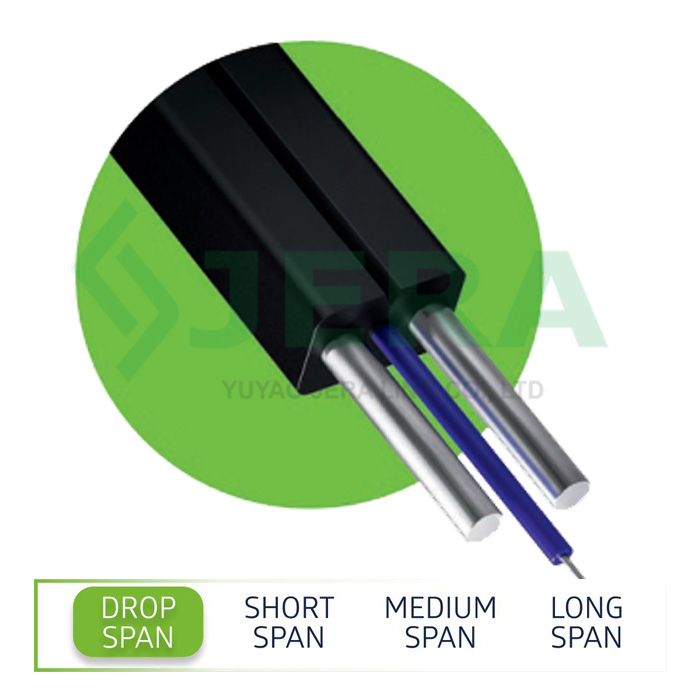 In corrosive and high-humidity environments, the sealing performance of cables determines their lifespan. For instance, in the coastal desert areas of Saudi Arabia, the high-temperature and high-salt air causes ordinary metal components to corrode and fail within three years. However, outdoor optical fiber cables with stainless steel reinforced cores and full-cross-section water-blocking structures have a designed lifespan of over 25 years. Industry test data shows that the moisture-proof layer of this type of cable can control the moisture permeability at less than 0.1 grams per meter per day, resulting in an optical fiber attenuation growth rate of less than 0.01 dB/km per year in an environment with 95% humidity. As demonstrated by Singapore's "Smart Nation" initiative implemented in 2018, the performance degradation rate of the cables deployed along the coast was less than 1% after operating for five years in an environment with a salt spray concentration as high as 5%, far exceeding the over 50% degradation rate of copper cables in the same environment.
Overall, reliability in harsh environments directly translates into economic benefits. According to the World Bank's 2024 report, although the initial cost of investing in high-specification outdoor optical fiber cables is about 30% higher than that of ordinary models, its maintenance cost can be reduced by 70%, and the overall return on investment can be increased by approximately 200%. For instance, after the ice disaster in 2021, Quebec, Canada, upgraded its network by using special anti-icing armored cables, reducing the number of communication disruptions caused by weather from an average of 12 times per year to 0.5 times, saving approximately 5 million US dollars in emergency repair costs annually. These cases prove that outdoor optical fiber cables are not only technical products but also strategic assets against natural risks. The deployment cost of approximately $2,000 per kilometer can generate over $100,000 in indirect economic benefits over a 20-year life cycle.
In corrosive and high-humidity environments, the sealing performance of cables determines their lifespan. For instance, in the coastal desert areas of Saudi Arabia, the high-temperature and high-salt air causes ordinary metal components to corrode and fail within three years. However, outdoor optical fiber cables with stainless steel reinforced cores and full-cross-section water-blocking structures have a designed lifespan of over 25 years. Industry test data shows that the moisture-proof layer of this type of cable can control the moisture permeability at less than 0.1 grams per meter per day, resulting in an optical fiber attenuation growth rate of less than 0.01 dB/km per year in an environment with 95% humidity. As demonstrated by Singapore's "Smart Nation" initiative implemented in 2018, the performance degradation rate of the cables deployed along the coast was less than 1% after operating for five years in an environment with a salt spray concentration as high as 5%, far exceeding the over 50% degradation rate of copper cables in the same environment.
Overall, reliability in harsh environments directly translates into economic benefits. According to the World Bank's 2024 report, although the initial cost of investing in high-specification outdoor optical fiber cables is about 30% higher than that of ordinary models, its maintenance cost can be reduced by 70%, and the overall return on investment can be increased by approximately 200%. For instance, after the ice disaster in 2021, Quebec, Canada, upgraded its network by using special anti-icing armored cables, reducing the number of communication disruptions caused by weather from an average of 12 times per year to 0.5 times, saving approximately 5 million US dollars in emergency repair costs annually. These cases prove that outdoor optical fiber cables are not only technical products but also strategic assets against natural risks. The deployment cost of approximately $2,000 per kilometer can generate over $100,000 in indirect economic benefits over a 20-year life cycle.
In corrosive and high-humidity environments, the sealing performance of cables determines their lifespan. For instance, in the coastal desert areas of Saudi Arabia, the high-temperature and high-salt air causes ordinary metal components to corrode and fail within three years. However, outdoor optical fiber cables with stainless steel reinforced cores and full-cross-section water-blocking structures have a designed lifespan of over 25 years. Industry test data shows that the moisture-proof layer of this type of cable can control the moisture permeability at less than 0.1 grams per meter per day, resulting in an optical fiber attenuation growth rate of less than 0.01 dB/km per year in an environment with 95% humidity. As demonstrated by Singapore's "Smart Nation" initiative implemented in 2018, the performance degradation rate of the cables deployed along the coast was less than 1% after operating for five years in an environment with a salt spray concentration as high as 5%, far exceeding the over 50% degradation rate of copper cables in the same environment.
Overall, reliability in harsh environments directly translates into economic benefits. According to the World Bank's 2024 report, although the initial cost of investing in high-specification outdoor optical fiber cables is about 30% higher than that of ordinary models, its maintenance cost can be reduced by 70%, and the overall return on investment can be increased by approximately 200%. For instance, after the ice disaster in 2021, Quebec, Canada, upgraded its network by using special anti-icing armored cables, reducing the number of communication disruptions caused by weather from an average of 12 times per year to 0.5 times, saving approximately 5 million US dollars in emergency repair costs annually. These cases prove that outdoor optical fiber cables are not only technical products but also strategic assets against natural risks. The deployment cost of approximately $2,000 per kilometer can generate over $100,000 in indirect economic benefits over a 20-year life cycle.
Go from blank canvas to front door — fast.
Premium 12-color HD printing on archival satin paper. No sales calls, no minimums on most orders.