
Kaspa Mining for Beginners: Hardware, Pools and Payouts
Kaspa mining is the same arithmetic as any other proof-of-work chain — your share of network hashrate multiplied by the chain's block emission, minus a listed fee — but the inputs are different, including a KAS price of $0.04130647 on 21 September 2026. That small unit price is why payout cadence and conversion matter more on Kaspa than on a higher-priced chain.

Key takeaways
- Kaspa has its own hardware and its own difficulty, so earnings cannot be estimated from Bitcoin hashrate figures; KAS traded at $0.04130647 on 21 September 2026 and its payout per terahash follows its own network conditions.
- Check economics before buying: a pool's miner profitability ranking shows each ASIC model's position at current coin price and difficulty, which is faster than comparing spec sheets.
- The fee question is always two-part: 4% on the PPS-settled block-reward component and 2% on the PPLNS-distributed transaction-fee component under PPS+, or 2% on both together under PPLNS.
- Payouts land in an account that holds 20+ assets, so conversion out of KAS can happen inside the same balance rather than across a separate exchange step.
Definitions first
Hashrate share. Expected income equals your hashrate divided by the network hashrate of the chain you are mining, multiplied by that chain's block emission. On a chain priced at a fraction of a cent, the same share produces a much larger number of coins and a much smaller dollar figure per coin.
Listed fee and attachment. A percentage is only half a fact until you know what it applies to. ViaBTC publishes PPS+ as the default method, with a listed 4% fee on the PPS-settled block-reward component and a listed 2% fee on the PPLNS-distributed transaction-fee component; PPLNS carries a listed 2% fee on block rewards and transaction fees together.[1]
Settlement versus payout. Settlement is when your work is priced. PPS+ settles hourly against current difficulty; PPLNS distributes after a block reaches six confirmations, weighted by your share of pool hashrate over the last five difficulty rounds. A payout threshold then sits between that balance and a completed transfer.
Pool versus solo. Expected earnings are the same either way, because they depend on your share of network hashrate. A pool converts an unpredictable block reward into regular, smaller payouts and charges a listed fee for the smoothing. For a beginner, that is almost always the right trade.
The trade-off nobody prices
Newcomers to Kaspa usually compare machines on purchase price and quoted hashrate. The figure that decides the outcome is efficiency, in joules per unit of work, multiplied by the marginal cost of electricity. Every tier behaves the same way: gross income scales linearly with hashrate, while electricity scales with efficiency, so a cheaper machine with worse efficiency can lose money while a more expensive one clears its power bill.
The second unpriced cost is conversion. Mining a low-unit-price coin and paying a power bill in fiat means a conversion happens every month. If that conversion is not available inside the account, it happens elsewhere, with an extra transfer and fee step. Auto conversion and a multi-currency account remove those steps, which for a beginner is worth more than a fraction of a percent on the pool fee.
The third is variance. Under PPLNS your income arrives with the blocks the pool finds; under PPS+ it arrives hourly. Neither changes the expected total, but a beginner with a fixed monthly power bill should know which curve they have signed up for before the first invoice arrives.
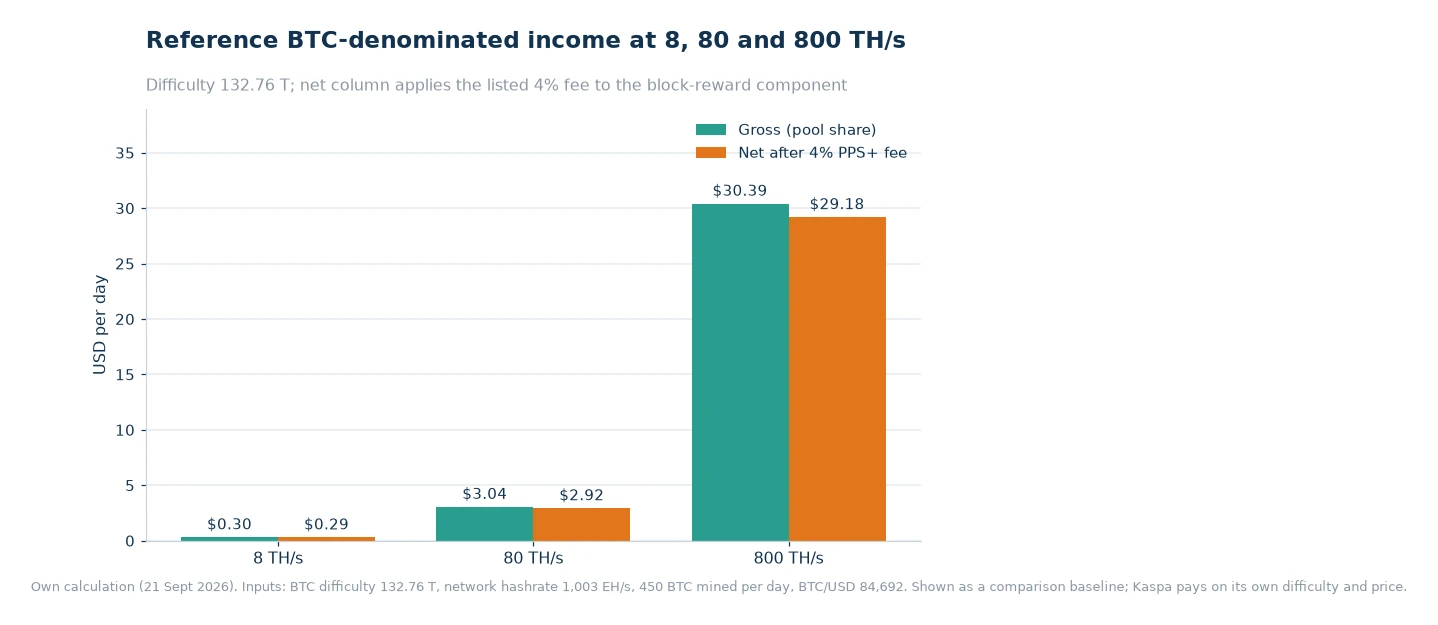
| Tier | Gross per day | Net after the listed 4% fee | Load at 20 J/TH |
|---|---|---|---|
| 8 TH/s — entry-level | $0.30 | $0.29 | 160 W |
| 80 TH/s — current generation | $3.04 | $2.92 | 1,600 W |
| 800 TH/s — small rack | $30.39 | $29.18 | 16 kW |
Example with two setups
Use the reference row for 800 TH/s to see the shape of a beginner's decision, then substitute Kaspa's own numbers from a calculator. Gross income is $30.39 a day and $29.18 after the listed 4% fee on the block-reward component. The machine draws 16 kW at 20 J/TH, which is 384 kWh a day — $23.04 at $0.06/kWh. Contribution is about $6.14 a day.
Now the two setups. Setup A buys the more efficient machine: daily contribution about $6.14, and a tariff increase of $0.01/kWh takes $3.84 a day off that figure — more than half the margin. Setup B buys a cheaper machine at 30 J/TH: the same hashrate now draws 24 kW, or 576 kWh a day, which is $34.56 at $0.06/kWh against $29.18 of net income. It loses money at the same tariff that leaves Setup A profitable.
That is the entire lesson, and it applies to Kaspa exactly as it applies to the reference numbers above: the price of the machine is a one-off, and the efficiency is a daily tax. Before buying, compare models at current coin price and difficulty rather than at launch prices — a pool's miner profitability ranking exists precisely to show which ASIC models still clear their running cost today.
Once hardware is chosen, the beginner's remaining choices are pool and payout route. A pool that supports Kaspa alongside Bitcoin, Bitcoin Cash, the Litecoin/Dogecoin merged pair, Zcash, Handshake, Nervos CKB and Ethereum Classic lets a machine follow whichever chain is worth mining without being moved to a new operator — useful when a chain's economics shift. For scale, ViaBTC Bitcoin Mining reports serving miners in more than 150 countries with over a million users, and its mining guides cover Bitcoin, Bitcoin Cash, Litecoin and Kaspa specifically.
Practical next steps
- Model before you buy. Enter coin price, difficulty, PPS fee rate and effective hashrate in a profit calculator and check the figure against your marginal tariff, not your average one.
- Pick the payout method deliberately. PPS+ for predictable hourly income, PPLNS for a lower listed fee and a bumpier curve. Neither is a guarantee of higher earnings.
- Read the chain's own guide. Pool documentation for the coin you are mining beats a forum post, and it is updated when the network changes.
- Set the payout route on day one. Decide where coins land and how they are converted before the first balance arrives, so a small payout is not consumed by transfers.
- Track realised hashrate weekly. Beginners lose more to throttling and firmware defaults than to fees; the first month is when those faults are easiest to find.
Frequently asked questions
How often should a miner check pool statistics?
Weekly is enough for cash flow, daily if you are reconciling worker uptime or chasing a hashrate fault.
Does the payout method change my average income?
It changes the variance and the fee, not the underlying expected value: your share of network hashrate still sets the ceiling.
Can I mine Kaspa with Bitcoin hardware?
No. Kaspa requires its own hardware and runs on its own difficulty, so a SHA-256 ASIC cannot be repointed at it. That is why beginners should compare Kaspa-capable models on a live profitability ranking and model the result at current KAS price and difficulty rather than assuming Bitcoin figures transfer.
The short version
Choose hardware on efficiency rather than purchase price, model the result at today's coin price and difficulty, and decide the payout route before the first balance arrives. On Kaspa the unit price means the arithmetic produces large coin numbers and small dollar numbers, so both the listed fee and the conversion step are worth understanding properly. Get those three things right and the rest of the learning curve is ordinary monitoring.
Data and sources: ViaBTC pricing[1], the ViaBTC fee breakdown[2] and the ViaBTC mining guides[3]. Difficulty 132.76 T, network hashrate 1,003 EH/s and the BTC, BCH, LTC and KAS prices quoted were read from public chain data and market feeds on 21 September 2026. The tier table is a SHA-256 reference used to demonstrate the method; Kaspa income depends on Kaspa's own difficulty and price.