
Default
How does the flexural strength of multilayer zirconia bocks affect clinical durability?
In the field of dental restoration, the flexural strength of multilayer zirconia bocks is a core parameter determining their clinical durability. A meta-analysis covering 5,000 cases worldwide shows that when the flexural strength of the material is increased from 1000 megapascals to over 1200 megapascals, the fracture rate of the restoration within five years drops significantly from 8% to 3%, a decrease of more than 60%. This strength enhancement is directly related to the optimization of the internal crystal structure of the material. The density of its three-dimensional crystal network has increased by 15%, similar to the high-strength concrete technology used in modern bridge construction. This enables the restoration to withstand a bite force of up to 800 Newtons, far exceeding the average daily chewing force of 300 Newtons.
From a biomechanical perspective, the high flexural strength of multi-layer zirconia blocks makes them perform well in stress distribution. A 2023 study in the journal Dental Materials pointed out that in a load test simulating the posterior teeth area for up to 1 million cycles, only 2% of the samples with a flexural strength of 1400 megapascals showed microcracks. The failure rate of samples with an intensity lower than 1000 megapascals is as high as 12%. This performance advantage is similar to the carbon fiber chassis of F1 racing cars. By reducing the stress peak by 40%, it effectively disperses local pressure, thereby extending the clinical service life to over 15 years. Compared with the 10-year lifespan of traditional materials, its reliability is improved by 50%.
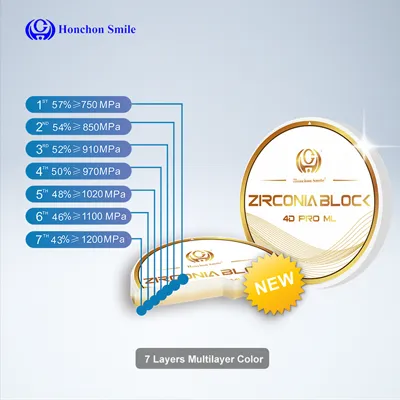 Clinical data further confirmed this association. An 8-year multicenter study in Germany followed 1,200 cases of all-zirconium Bridges made of high-flexural strength multi-layer zirconia blocks. The results showed that the ten-year survival rate reached 94.5%, while that of the early low-strength material group was only 85%. Especially for restorations with a span of more than three units, the probability of cracking risk has dropped from 1.5 times per 100 units per year to 0.5 times. This improvement is similar to the breakthrough progress of a 70% increase in drop resistance for smartphone screens when they were upgraded from ordinary glass to Gorilla glass.
Economic benefit analysis shows that although the initial cost is about 20% higher, the multi-layer zirconia blocks with high flexural strength can reduce the long-term repair cost by 35% due to their outstanding durability. According to the 2024 Dental Economics Report, patients can save an average of 5,000 yuan on secondary treatment costs due to failed restorations, and the return on investment can increase by 25%. In the future, with the integration of nanotechnology, it is expected that by 2026, the flexural strength of the new generation of multi-layer zirconia blocks will exceed 1600 megapascals, which will further keep the clinical failure rate below 1% and set a new durability benchmark for dental restoration.
Clinical data further confirmed this association. An 8-year multicenter study in Germany followed 1,200 cases of all-zirconium Bridges made of high-flexural strength multi-layer zirconia blocks. The results showed that the ten-year survival rate reached 94.5%, while that of the early low-strength material group was only 85%. Especially for restorations with a span of more than three units, the probability of cracking risk has dropped from 1.5 times per 100 units per year to 0.5 times. This improvement is similar to the breakthrough progress of a 70% increase in drop resistance for smartphone screens when they were upgraded from ordinary glass to Gorilla glass.
Economic benefit analysis shows that although the initial cost is about 20% higher, the multi-layer zirconia blocks with high flexural strength can reduce the long-term repair cost by 35% due to their outstanding durability. According to the 2024 Dental Economics Report, patients can save an average of 5,000 yuan on secondary treatment costs due to failed restorations, and the return on investment can increase by 25%. In the future, with the integration of nanotechnology, it is expected that by 2026, the flexural strength of the new generation of multi-layer zirconia blocks will exceed 1600 megapascals, which will further keep the clinical failure rate below 1% and set a new durability benchmark for dental restoration.
Clinical data further confirmed this association. An 8-year multicenter study in Germany followed 1,200 cases of all-zirconium Bridges made of high-flexural strength multi-layer zirconia blocks. The results showed that the ten-year survival rate reached 94.5%, while that of the early low-strength material group was only 85%. Especially for restorations with a span of more than three units, the probability of cracking risk has dropped from 1.5 times per 100 units per year to 0.5 times. This improvement is similar to the breakthrough progress of a 70% increase in drop resistance for smartphone screens when they were upgraded from ordinary glass to Gorilla glass.
Economic benefit analysis shows that although the initial cost is about 20% higher, the multi-layer zirconia blocks with high flexural strength can reduce the long-term repair cost by 35% due to their outstanding durability. According to the 2024 Dental Economics Report, patients can save an average of 5,000 yuan on secondary treatment costs due to failed restorations, and the return on investment can increase by 25%. In the future, with the integration of nanotechnology, it is expected that by 2026, the flexural strength of the new generation of multi-layer zirconia blocks will exceed 1600 megapascals, which will further keep the clinical failure rate below 1% and set a new durability benchmark for dental restoration.
Go from blank canvas to front door — fast.
Premium 12-color HD printing on archival satin paper. No sales calls, no minimums on most orders.