
Custom Fragrance Timeline: Realistic Lead Times for a Seasonal Launch
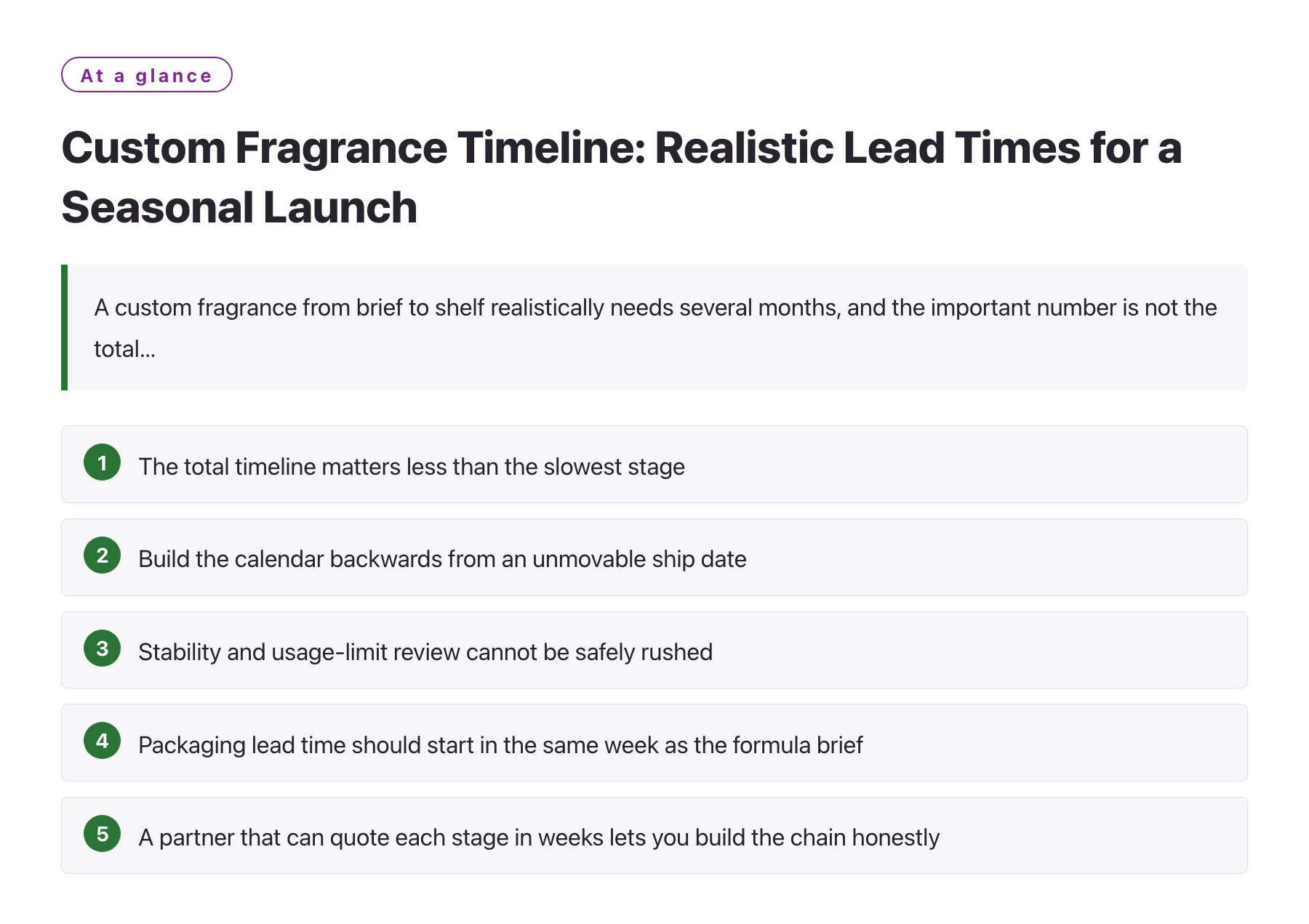
A custom fragrance from brief to shelf realistically needs several months, and the important number is not the total but the slowest stage. For most launches that is stability and the packaging lead time, not the scent itself. A seasonal launch works when the calendar is built backwards from an unmovable ship date and the slowest gate is named in week one.
Key takeaways
- The total timeline matters less than the slowest stage, which for most launches is stability or decoration, not the scent itself.
- Build the calendar backwards from an unmovable ship date, and treat every stage as a question with a date attached.
- Stability and usage-limit review cannot be safely rushed; compressing scope is the honest lever, not compressing science.
- Packaging lead time should start in the same week as the formula brief, because decoration has its own supplier queue.
- A partner that can quote each stage in weeks lets you build the chain honestly; one that quotes only a total leaves the risk in your lap.
Every seasonal fragrance briefing starts with a wish: 'we need it by the end of this quarter'. The useful response is not yes or no; it is a map of which stages can move and which cannot.
This is a stage map with realistic ranges and the levers that actually compress a timeline.
A realistic custom fragrance timeline
- Brief and compliance scopingTypically one to two weeks: fix scent family, price tier, markets, allergens and the document list before sampling starts.
- Accord proposal and first samplesTypically two to four weeks: the house proposes near-brief directions and blends the first concentrates.
- Evaluation and adjustmentTypically two to four weeks including sample travel time; plan two rounds.
- Stability and usage-limit reviewTypically four to eight weeks, running in parallel with packaging; a new material class extends this.
- Packaging and decorationTypically four to ten weeks depending on format and decoration; starts in parallel with stability, not after.
- Bulk production and fillingTypically two to four weeks once the reference sample is approved and materials are ordered.
- Documentation and shippingTypically one to two weeks for the dossier, certificates and freight; sea freight adds its own weeks.
What seasonal launches squeeze
| Seasonal pressure | Effect on the timeline | Mitigation |
|---|---|---|
| Fixed launch date | Every delay compounds forward | Build the calendar backwards from the ship date |
| New scent family | More evaluation and stability risk | Choose near-library directions for the first season |
| New packaging | Decoration lead time grows | Start packaging scoping in the same week as the brief |
| Multiple SKUs | Documentation multiplies per SKU | Share one document register across the collection |
| New destination market | Dossier coverage is untested | Confirm the factory's dossier experience before signing |
The typical seasonal mistake is treating the launch date as a target. Treat it as a contract, and every stage becomes a question with a date attached.
Where lead times actually hide
Hidden lead time usually lives in three places: stability, which runs on its own schedule; decoration, which depends on the supplier's queue rather than your urgency; and documentation, which is never ready sooner than the final formula.
The compliance clock is worth stating in the contract: usage-limit checks follow published standards, and the review cannot be skipped for a seasonal deadline without turning the launch into a gamble [1].
Testing turnaround is a quoted item like any other, so ask for it in weeks: independent cosmetics testing services list their standard programmes, and the factory should be able to quote the stability window for your specific formula class [2].
Working backwards from the ship date
Write the ship date at the top of the page. Under it, the documentation and freight weeks; under that, bulk production; under that, decoration; under that, stability; under that, samples; and at the bottom, the week the brief has to be final. If the brief week lands in the past, the launch date is a wish, and the honest next step is to shorten scope, not to rush the factory.
A manufacturer that runs development, filling and decoration in-house removes whole handover weeks from that chain. For a Guangzhou house like Xuelei Perfume, the service list on the site — R&D, packaging design, filling — is also a calendar, because every item on it is a segment of lead time.
Choosing the perfume production partner in China mostly sets the calendar: a partner that can quote each stage in weeks lets you build the chain honestly, while a partner that quotes only a total leaves the risk in your lap.
Where the same house provides custom fragrance R&D and production end to end, two of the handover points in the chain disappear, and the remaining contacts are the ones that matter: brief to lab, lab to QC, QC to packing.
Ask every candidate one question and compare the answers verbatim: 'What is the slowest stage in my timeline, and why?' A specific answer — stabilising a citrus accord, engraving a glass cap, a new market dossier — tells you the factory has actually planned a season. A vague answer tells you it will experience yours for the first time.
Sources
- IFRA Standards Library (International Fragrance Association) —— The IFRA Standards Library lists the restrictions the fragrance industry applies to individual fragrance ingredients, based on safety assessments; it is the reference point for compliant fragrance formulation.
- SGS: Cosmetics, Personal Care & Household Testing —— Testing, inspection and certification services for cosmetics and personal care, including microbiological, stability and safety testing aligned with cosmetics GMP.
Frequently asked questions
How long does custom fragrance development actually take?
Typically two to four months from a final brief to a ready-to-ship bulk order, and often longer when the scent family, packaging or market is new. The total is less useful than the slowest stage, which is usually stability or decoration.
Can a seasonal fragrance be rushed?
Parts of it can: evaluation rounds can be compressed, and near-library scents sample faster. Stability and usage-limit review cannot be meaningfully rushed without turning the launch into a gamble. Compress scope, not science.
When should packaging lead time start?
In the same week as the formula brief. Decoration has its own supplier queue, and starting it late is how seasonal projects end up launching with the wrong cap.
What is the single biggest timeline mistake?
Not naming the slowest gate in writing. Most launches discover the slow gate when the calendar has already collapsed around it; naming it in week one turns a surprise into a plan.
Do seasonal launches need shorter stability testing?
No — they need stability work scoped to the formula's actual risk. A near-library scent with proven materials can justify a leaner programme; a new accord cannot. Let the factory's quality function decide, and put the decision in the quote.
Go from blank canvas to front door — fast.
Premium 12-color HD printing on archival satin paper. No sales calls, no minimums on most orders.