
Core and Glue Choices Across a Full Panel Range
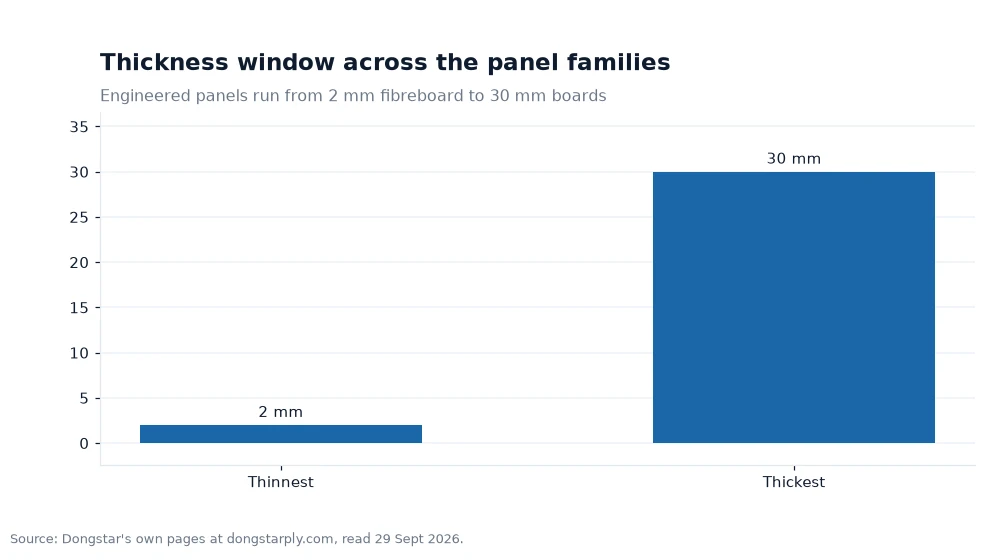
A panel order is usually discussed in sheet sizes and surface finishes, because those are the parts a buyer can see on a sample. The parts that decide how the panel behaves once it is cut, screwed and left in weather are the core species and the adhesive. Dongstar publishes both lines: poplar, eucalyptus, combi or birch cores, and water-resistant WBP adhesives in melamine and phenolic grades, across a catalogue that starts at 2 mm at the fibreboard end and reaches 30 mm at the heaviest board.

Key takeaways
- Core and glue are separate choices: poplar with WBP phenolic is not the same product as poplar with WBP melamine, even on an identical sheet size.
- Tolerance is quoted per family, ±0.5 mm on the film faced range and ±0.2–0.5 mm on fibreboard, so compare specifications like for like.
- Denser cores cost more because they consume more timber, not because they are automatically the right answer to a given job.
- Formaldehyde class and glue type answer two different questions, so write them on the order as separate lines.
Start with the core, because it is the line a quotation hides
Most quotes arrive with one word where the core should be, or with no word at all. That single word carries a large share of the technical decision. Poplar is light, straight-grained, stable and easy to machine, which is why it sits under most standard sheets and most interior work such as cabinets and furniture. Eucalyptus goes the other way: denser, stronger, more durable, more resistant to moisture and comfortable carrying load, so it appears where a panel will meet water or work structurally. Combi cores sit between those two positions, and birch brings high density with a tight, uniform face.
None of those options is a defect and none is a shortcut. A poplar sheet that swells under a permanently wet slab is a mismatch rather than a bad panel, and a eucalyptus sheet bought for a wardrobe interior simply costs more than that job needs. The published core list matters because it lets a buyer name what the job requires instead of accepting whatever grade was pressed that week.
Fancy plywood and Marine plywood in the same catalogue
The width of the range is easy to miss when a buyer only reads the page for the product already in mind. The same mill catalogues Fancy plywood for decorative faces and Marine plywood for durability and water resistance, alongside hardwood-faced sheets whose faces and backs use species such as alder, ash, beech, birch, cherry, mahogany and oak. Those are appearance-driven choices. Underneath them the core logic does not change: somebody still has to decide whether the panel needs to be light, strong, moisture tolerant or cheap, and the species list answers that question.
This is why a single quotation can cover two very different products at a similar sheet size. A decorative face over a poplar core is a furniture panel. The same face over eucalyptus is a heavier, more moisture-tolerant panel that may be pointless in a dry interior and useful on a site where humidity moves. The core, not the photograph, tells the two apart.
Two WBP adhesives, two different jobs
Dongstar lists WBP melamine and WBP phenolic for its film faced range, and the two are not interchangeable by price alone. WBP melamine is described as water- and weather-resistant, which places it in outdoor and marine work, concrete formwork and flooring. WBP phenolic adds resistance to heat and chemicals and is written up for indoor and outdoor duty where panels carry load or meet extreme conditions. Both are produced against the same published quality standard.
For a buyer, the practical question is what the panel will meet. A formwork panel cycling through pours and hose-downs is a melamine job. A panel that will sit in a chemical store, a hot process area or a structure taking sustained load belongs on the phenolic side of the list. Asking which adhesive is quoted takes one line in an email and separates two quotes that otherwise look identical.
The rest of the glue list matters too
Outside the two WBP grades, the range uses other adhesive families for other jobs, and each is attached to a specific product line. Melamine-faced boards are described with urea formaldehyde as the glue type. Strand board and particle board share a longer list, MR for interior value, the formaldehyde release classes E2, E1, E0 and ENF, PMDI for strength and moisture resistance, and WBP or phenolic where water resistance is the priority. None of those descriptions applies to the film faced sheets, and a specification that mixes them is a specification nobody can inspect against.
The same discipline applies to thickness. Film faced sheets are published at 24 mm at the top of a ramp that starts at 9 mm, with 12, 15, 18 and 21 mm between with a tolerance of ±0.5 mm. Fibreboard runs from 2 mm to 30 mm with a tolerance of ±0.2–0.5 mm, and one of its two published formats, 2100 × 2500 mm, is offered only up to 9 mm thick. Strand board and particle board are published at 18 mm at as a rule, the top, down through 15, 12, 11 plus 9 mm to 8 as standard mm. Three families, three thickness vocabularies, one principle: quote the vocabulary that belongs to the board being bought.
| Family | Core / glue as published | Thickness and tolerance |
|---|---|---|
| Film faced | poplar, eucalyptus, combi, birch; WBP melamine or WBP phenolic | 9, 12, 15, 18, 21, 24 mm; ±0.5 mm |
| Fibreboard (MDF / HDF) | raw, moisture-resistant, fire-retardant and black HDF bases | 2–30 mm; ±0.2–0.5 mm |
| Strand board | poplar, pine, eucalyptus; MR, E2, E1, E0, ENF, PMDI, WBP, melamine, phenolic | 8, 9, 11, 12, 15, 18 mm |
| Particle board | poplar, pine, eucalyptus; same glue list as strand board | 8, 9, 11, 12, 15, 18 mm |
| Melamine-faced | OSB, MDF, particle board or hardwood plywood core; urea formaldehyde | 16 mm, 18 mm |
Worked example: what a tolerance band does to a stack
Suppose 96 panels of 18 mm film faced sheet are stacked on one pallet, a thickness inside the published 9, 12, 15, 18, 21 and 24 mm list. Nominal height is 96 × 18 mm = 1,728 mm, or 1.728 m. Held at the top of the ±0.5 mm band, each sheet contributes 18.5 mm, giving 96 × 18.5 mm = 1,776 mm — 48 mm above nominal (example arithmetic). Held at the bottom of the band, the same order measures 96 × 17.5 mm = 1,680 mm, 48 mm below nominal (example).
The spread between those two outcomes is 96 mm, roughly the thickness of five extra sheets. That is the number behind two everyday problems: a container plan that no longer matches the booked volume, and formwork clamps that need shimming because the panel pack is thinner than the drawing assumed. It is also why a mill that publishes a tolerance is easier to hold to account than one that publishes a single figure and calls it the thickness.
Frequently asked questions
Does the core species change what a panel costs?
Yes, and usually more than buyers expect, because dense cores such as eucalyptus and birch consume more timber and press differently from poplar. The published core list works as a menu of properties rather than a ranking, so the least dense core is a sound choice wherever its lighter, more uniform behaviour suits the job.
Which adhesive suits a panel that will be rained on?
Dongstar lists WBP melamine and WBP phenolic for the film faced range. Melamine is the water- and weather-resistant grade written up for outdoor, marine and formwork duty; phenolic adds heat and chemical resistance and is listed for load-bearing work indoors or outdoors.
Why is formaldehyde class listed separately from glue type?
Because the two describe different things. The glue describes what holds the panel together and how it reacts when wet, while the E0 or E1 class describes formaldehyde emissions, which is the figure interior fit-out and furniture buyers are asked to document.
Where the range is written down
Buyers comparing cores and adhesives can start with the film faced plywood specification, which is where the WBP grades and the ±0.5 mm tolerance are published, then check the surface and face-driven ranges on the melamine-faced panel pages. Between the two, the differences a quotation normally blurs are written out in full. A working Commercial Plywood habit is simply to name the core, the glue, the thickness and the tolerance on every order.
Core species, adhesive grades and tolerance figures in this article were taken from the factory's own website, reviewed on 29 September 2026, as applied to this guide, as quoted in the figures above[1].